


Restoring Lands, Safeguarding Livelihoods: Empowering Niger Delta Women Through Localised Bioremediation
In response to the persistent devastation caused by oil spills across the Niger Delta and the absence of immediate government interventions, Kebetkache Women Development & Resource Centre hosted a comprehensive two-day programme on July 23rd and 24th, 2026. Held under the auspices of the Polluter Pays Project, the initiative featured a community remediation engagement at Yenagoa, followed by an intensive field technical visit to Otuabagi community in Ogbia Local Government Area, Bayelsa State.
The engagement brought together 35 participants, 28 women and 7 men, equipping grassroots leaders with theoretical knowledge and practical, hands-on skills in bioremediation, shoreline cleanup, and environmental monitoring. Beyond mitigating immediate ecological hazards, the training seeks to foster socioeconomic development by opening community-level job opportunities in cleanup and environmental restoration.
Opening Perspectives & Technical Insights
Welcoming participants to the workshop, Dr. Emem Okon, Executive Director of Kebetkache Women Development & Resource Centre, underscored the urgency of equipping women with functional environmental restoration skills. Pointing to the prolonged lack of visible government intervention in Otuabagi, Dr. Okon urged participants to embrace bioremediation as a vital emergency response mechanism to contain oil spills at the frontline and replicate these skills across their respective communities.
"Women are the primary custodians of household food security and rural livelihoods. equipping them with localized bioremediation tools is an imperative first line of defense when systemic interventions fail." - Dr. Emem Okon, Executive Director, Kebetkache Women Development & Resource Centre

Delivering the technical modules, Dr. Kabari Sam, Senior Lecturer in Environmental Systems at the University of Portsmouth, detailed the continuum of environmental recovery spanning cleanup, remediation, resuscitation, and ecosystem restoration. He emphasised that achieving a healthy environment directly links to safe drinking water, productive farming, viable fishing, clean air, and sustained household income.
Key Concepts & Environmental Pathways Covered:
Contamination vs. Pollution: While pollution damages ecosystems, environmental contamination occurs when harmful substances reach levels that directly destroy life, such as aquatic organisms dying from blocked oxygen due to oil sheens on water bodies.
Pollutant Profiles: The Niger Delta environment is saturated with physical (plastics, sediment), biological (bacteria, pathogens), and chemical contaminants, specifically crude oil, diesel, heavy metals, Polycyclic Aromatic Hydrocarbons (PAHs), and BTEX compounds.
Contamination Pathways: Contaminants move from spill points through soil and groundwater into rivers and marine life, ultimately impacting human health through ingestion, inhalation, and skin contact.
Health Risks & Precautionary Action: Exposure to these petroleum hydrocarbons poses severe risks, including skin irritation, respiratory illness, organ damage, and reproductive health challenges. Participants were advised to boil water prior to domestic use to limit exposure to heavy metals and organic solvents.
Distributive Justice: Dr. Sam highlighted the principle of distributive justice, noting the stark inequity where frontline communities bear the entire burden of pollution without benefiting from the resources extracted from their lands.
Low-Cost Bioremediation & The Practical Field Visit
To bridge theoretical concepts with frontline realities, the team and community members visited the legacy Oil Well 2 site in Otuabagi, the historic origin of commercial oil extraction in Nigeria. The site remains severely compromised, with crude oil leaking from the wellhead into surrounding farmlands, polluting the air, and stripping the soil of essential nutrients and oxygen.

Dr. Matthew, representing the Hydrocarbon Pollution Remediation Project (HYPREP), sensitised participants at the site, explaining that legacy sites require complete decommissioning alongside deep remediation. In the interim, training women in accessible, low-cost bioremediation serves as a critical stopgap measure.
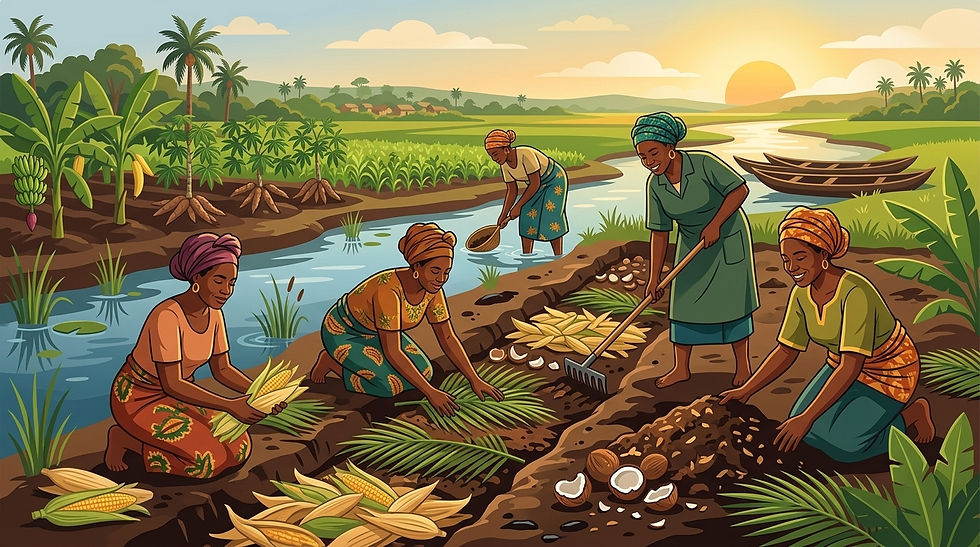
The field exercise allowed community women to share their own indigenous containment practices, such as using palm fronds and grasses, while learning how to combine these with natural organic wastes (corn husks, orange peels, coconut husks, and agricultural residues) to stimulate natural microbial breakdown of hydrocarbons on their farmlands.
Core Outcomes & Key Lessons
Outcome / Lesson Area | Strategic Value & Summary |
Capacity Enhancement | 35 community stakeholders acquired practical competencies in identifying contamination pathways, assessing environmental risks, and deploying emergency spill containment. |
Low-Cost Remediation | Women gained direct experience converting household organic waste into functional bioremediation tools to protect farmlands while awaiting formal intervention. |
Indigenous Knowledge Integration | Local coping strategies were validated and integrated with scientific approaches, establishing a holistic framework for community response. |
Frontline Action | Confirmed that women act as the true first responders during environmental disasters due to their direct reliance on land and water resources for family survival. |
Community Ownership | Demonstrated that community participation and early reporting are essential for long-term ecosystem recovery and advocacy. |
Recommendations for Duty Bearers & Stakeholders
State & Federal Government Agencies: Prioritise the immediate, comprehensive remediation and decommissioning of legacy oil spill sites across Otuabagi and neighbouring Ogbia communities.
Operating Oil Companies: Fulfil legal environmental obligations through prompt spill containment, thorough site restoration, and fair compensation to affected landholders.
Capacity Expansion: Scale up training initiatives to accredit women and youth as official community environmental monitors and emergency first responders throughout Bayelsa State.
Institutional Support: Expand Kebetkache’s grassroots leadership programmes, supporting continuous environmental advocacy, regular refresher workshops, and field demonstrations across the region.
Moving Forward
The Otuabagi engagement reinforces Kebetkache's commitment to advancing environmental justice through empowered female leadership. While the ongoing pollution at legacy sites underlines an urgent need for state and corporate accountability, equipping frontline women with practical, localised bioremediation tools ensures communities can defend their health, lands, and livelihoods today. Kebetkache will continue to stand alongside Niger Delta communities, providing the knowledge, advocacy tools, and technical backing necessary to achieve lasting environmental recovery.
Kindly follow us for more updates on our social media pages – Facebook, Twitter, YouTube and listen to our Podcast on Spotify.


Comments